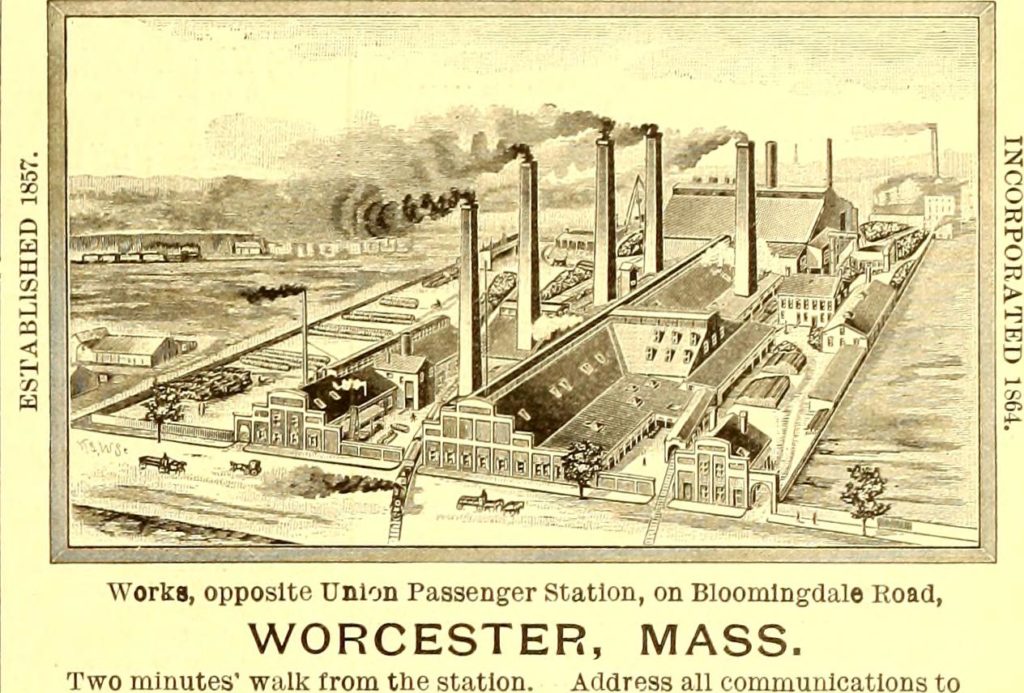
Part of a Worcester Steel Works advertisement shows the factory complex on Bloomingdale Street in the 1880s. (The Street Railway Journal, December 1887)
Major Taylor’s employer and mentor, Louis “Birdie” Munger, bought the massive New England Steel Co. plant at 14 Bloomingdale St. when he came to Worcester in 1895 and converted it to a bicycle factory. The Worcester Cycle Manufacturing Co. occupied several buildings on seven acres across the railroad tracks from the original Union Station, built in 1875 slightly east of the current train station.
The plant “is well equipped for the making of open hearth steel, steel castings and forgings,” The Iron Age reported on October 10, 1895, under the heading “Bicycle Notes.” With the addition of a new building for a machine shop, Munger’s company began turning out lightweight bicycles with names such as the Boyd, the Birdie, and Royal Worcester. High-end models sold for $125. A second factory was opened in Middletown, Connecticut, along with offices in New York City.
The Worcester Cycle Manufacturing Co. only lasted a couple of years. Workers went on strike in June 1897 after wages were cut, and the company went into receivership that summer. By then Taylor was earning good money as a professional bike racer.
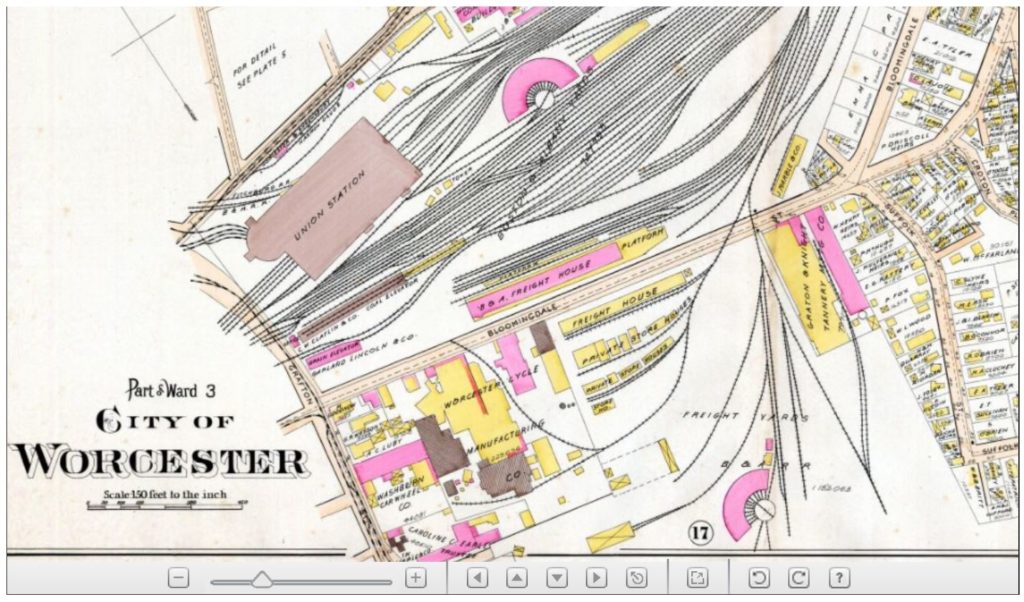
An 1896 map shows the Worcester Cycle Manufacturing Co. on Bloomingdale Street. (Worcester 1896, L.J. Richards & Co.)
Part of the Worcester factory location later became home to the Worcester Cold Storage and Warehouse Co. A raging fire destroyed a vacant six-story building from that former business on December 3, 1999, and claimed the lives of six Worcester firefighters. The Franklin Street fire station and firemen’s memorial now stand on the site of the warehouse that burned down.