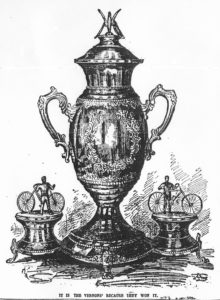
A drawing of the gold and silver cup for the winner of the Telegram Trophy Race dominated the front page of the Sunday Telegram the day after the race. Coverage of the event took up more than two full pages of the newspaper. (Sunday Telegram, May 10, 1896)
After his first winter living in the Northeast, 17-year-old Major Taylor found many springtime opportunities to test his ability against the country’s top amateur cyclists. The 10-mile Telegram Trophy Race was the first big contest of the 1896 season.
The start was to be at Park Avenue and Grove Street but was moved about 100 yards up Park Avenue at the last minute because of poor road conditions at the intersection. The Vernon Bicycle Club members had a tent for their warmups in “Salisbury’s field” near the starting line, while a barn and a house on Grove Street served that purpose for some of the other teams.
Thousands of spectators lined the course, which zig-zagged to Newton Square, Webster Square, and Tatnuck Square before descending past Institute Park to the finish back on Park Avenue near Grove.
The winner was James J. Casey of the Vernon Bicycle Club.
Taylor rode with the Albion Cycle Club, a club formed in 1895 by and for black riders. He garnered mentions in the Telegram’s extensive coverage for boosting the pace on Mill Street and for his close pursuit of the leader on Chandler Street. He led the Albions in points and placed sixth overall, among 25 finishers.
The Telegram race was a victory of another sort for Taylor. In previous years in Indianapolis, he had found his prospects effectively limited to black clubs and black races. In the Worcester race, blacks and whites competed on equal footing, and the Albion club’s black members also shared in official duties as timers, starters, and course marshals. The racial integration of the event drew no protest or hostility, or at least no such mention in the newspaper.
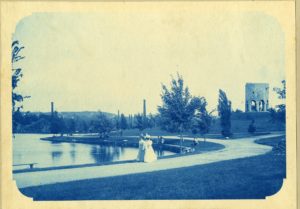
Institute Park in 1902 (From the collections of Worcester Historical Museum)